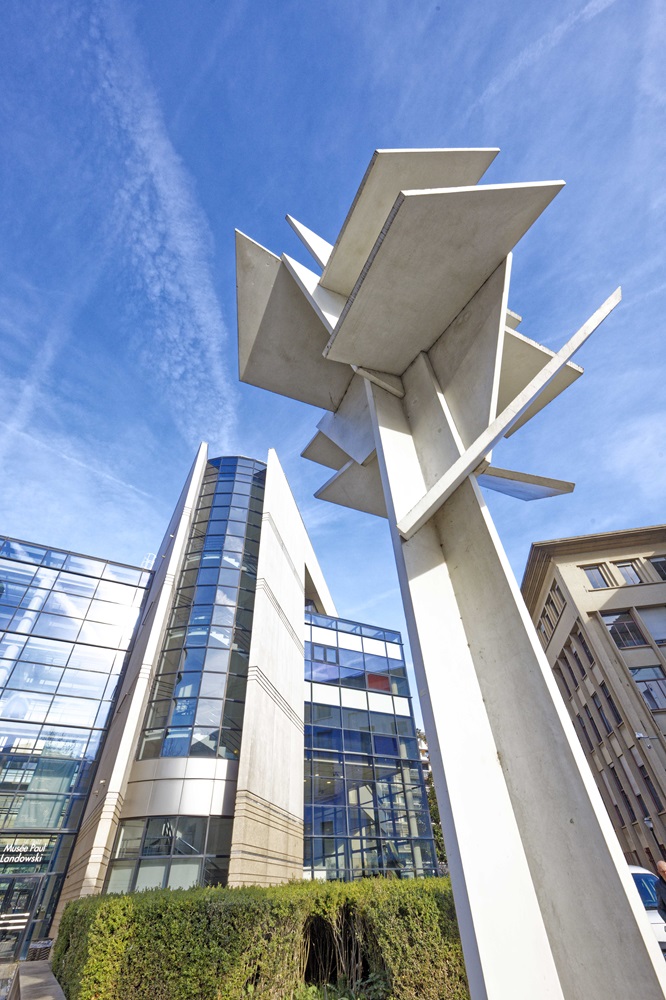
Cubist sculpture in reinforced concrete, a symbol of modernity
The 1925 International Exhibition of Modern Decorative and Industrial Arts in Paris marked a pivotal moment in art history. For six months, this event showcased a vast array of artistic and industrial creations, including furniture, tapestries, jewelry, and contemporary works. Among the remarkable pieces, the Cubist Tree, a work by sculptors Joël and Jean Martel, whose workshops were in Boulogne-Billancourt, in collaboration with architect Robert Mallet-Stevens, stood out as a centerpiece of the exhibition.
This work aimed to demonstrate "the finesse of construction that can be achieved with reinforced concrete" and to explore "an aesthetic and decorative research, based on the juxtaposition or superposition of similar elements, or their arrangement in various orientations" (Joël Martel, Bulletin de la vie artistique, August 1, 1925).
In 1998, a replica in concrete and resin of the Cubist Tree, one third larger than the original to fit into the site, was created by the architects Marc Mimram and Alexandre Chemetoff.
It was entirely funded by a fundraising campaign and installed in front of the Landowski space in Boulogne-Billancourt. This sculpture, reaching a height of 8.50 meters and made of Ductal® (Ultra High Performance Fiber Reinforced Concrete from Bouygues Construction), is a technical and artistic feat. Its trunk is prestressed by bonded wires, and the material's characteristics allowed for a complex attachment of the leaves, made from concrete slabs less than 6 cm thick.
The history of this work, the artists involved, and its influence on modern art continue to inspire current and future generations.
Over time, this tree has become one of the symbols of Boulogne-Billancourt.